Thursday, November 17, 2011

La Rochelle

During our holiday in Fouras we also went to La Rochelle the one day.  To watch the new Steven Spielberg movie Tintin (Kuifie vir die Afrikaanssprekendes) - excellent! We've really enjoyed it.  By the time we got out of the movies it was almost time to have dinner, so we drove to the heart of La Rochelle.  Fortunately JL knew a good restaurant, well known for its seafood.  I had fish soup for a starter (I really love the French fish soup and this one was the best I've ever had!) and then moules frites for my main meal, while JL enjoyed a seafood platter and a fish.  So for those of you who plan to visit La Rochelle some time - remember the name André.  During season you will have to book a day or two in advance, as they are very popular.  The decor inside was welcoming, the service good and the food excellent!  They are situated very close to the old harbour - vieux port (La Rochelle has 3 harbours).
As it was already dark by the time we got there, I left the camera in the car.  But I'll share some photos of La Rochelle with you we took during my first visit to the Charente. 
La Rochelle is becoming increasingly popular with Parisians, as it is only 3 hours by TGV.  At the start and end of a weekend you'll have difficulty to find a seat on the TGV. It was recently voted as one of the preferred places in France to live in. 
It was the first place in France to start with the concept of having bicycles available for tourist (the velib concept you'll find nowadays in Paris). 
They host an annual music festival in July, the Francofolies, attended by thousands of people.  We've watched the broadcast on television, good musicians, worth it to include in your travel programme.
La Rochelle was the capital of protestantism.  Henri IV's mother was a protestant and when he became king of France, he established the edict of Nantes to bring peace between the two religions.  However, after his death in 1610 La Rochelle was no longer secure.  Louis XIV & his friend Richelieu wanted to destroy La Rochelle.  However, the mayor Jean Guiton (whose statue is nowadays in front of the city hall) came up with a big defense, although eventually in vain.  After 13 months of being surrounded La Rochelle had to give in, the town lost its privileges, the commerce was destroyed as were the fortified city walls.  Guiton's life was saved, but he was exiled.
La Rochelle started of as a fishers' village, but from the 12th century it became an important harbour for exporting wine and salt.  This was the time of Elianor of Aquitaine.  She was married to the French king but divorced him in 1152 whereafter she married the king of England in 1154 - and La Rochelle, then being part of the Aquitaine, became English property. (This divorce and marriage were one of the main reasons of the wars between England and France.  La Rochelle changed hands between the English and the French several times.) OK, enough history, the photos:
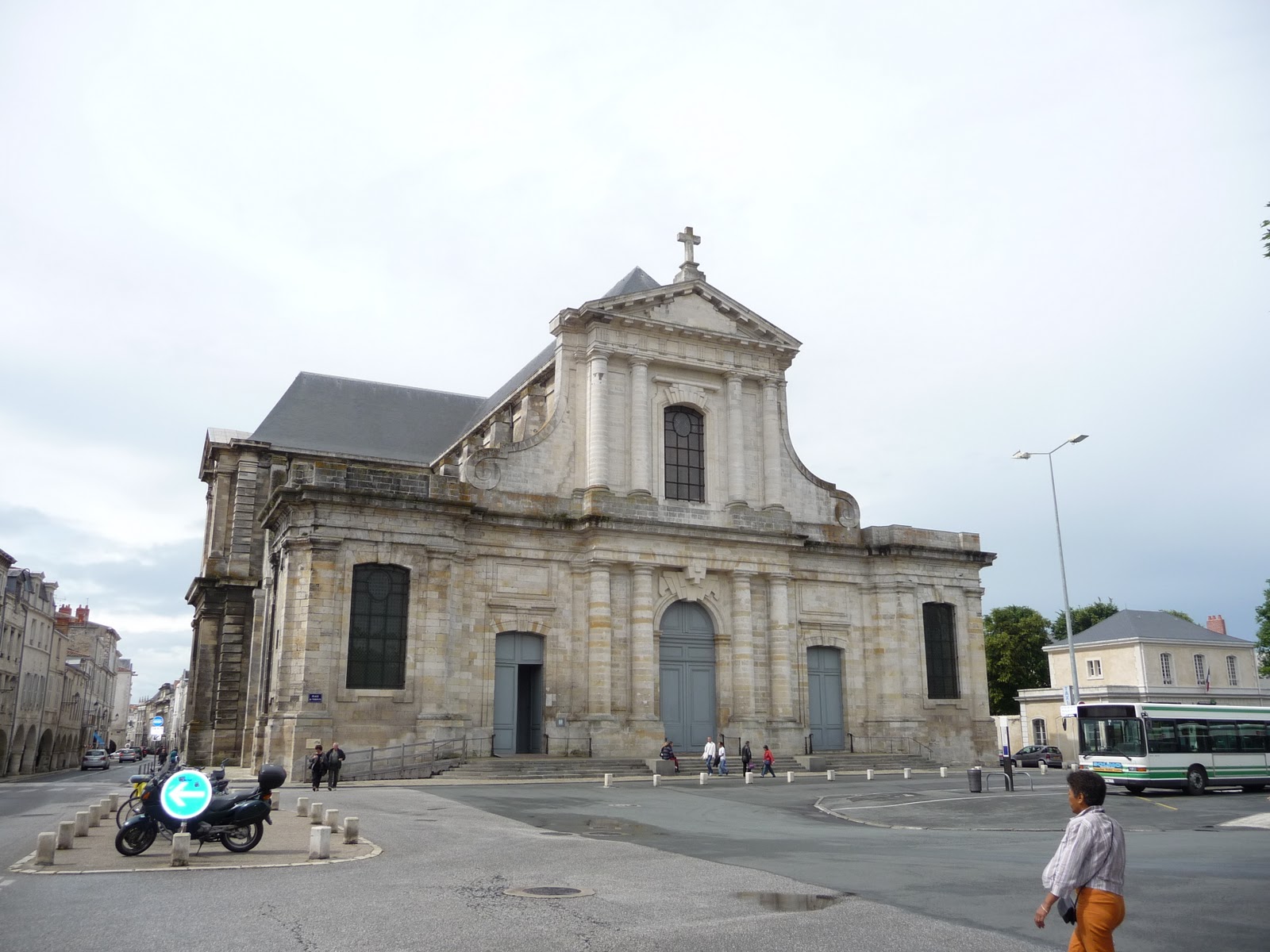
Above: if you arrive by car, you'll see this church next to an underground parking
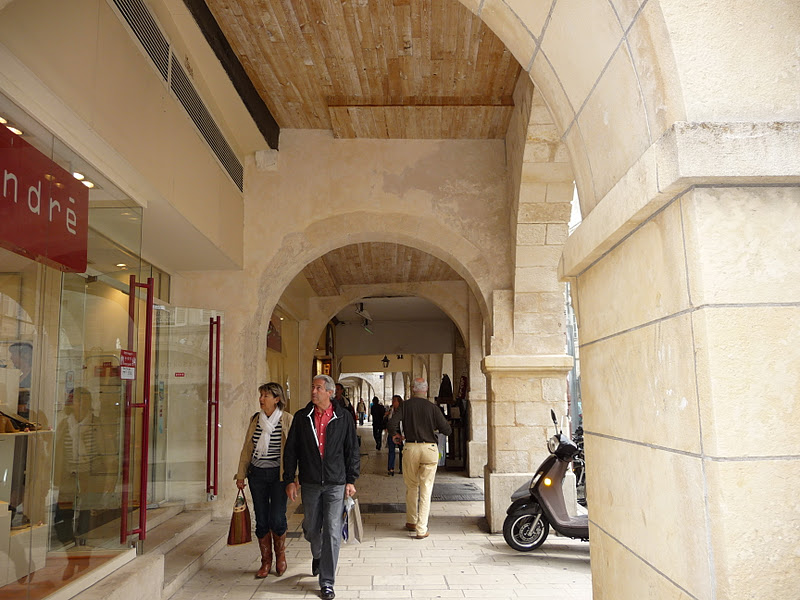
Below: the arcades are very distinctive of La Rochelle and originated in the 13th century, used by merchants to display their goods

Like most other towns and villages they have a market
You'll find timbered houses from the 15th & 16th century
the square in front of the hôtel de ville, above the statue of Guiton
The hôtel de ville was constructed in phases from the 15th - 19th centuries and is witness to the historical prosperity of the region (except for the one below with another one of Guiton's statue, the others are all of the hôtel de ville, like the two above)
Below: the latest addition to the hôtel de ville
Above: the towers of the old port, one was a donjon (a jail)
Below: La Grosse Horloge (the big clock, that is the tower) - it was part of the city walls, in the 13th century one of the gates linking the port with the old town. It had some alterations over time, but it still link the pedestrian zone with the port
Above: the tree lined area that provided access to the port
Below: the medieval towers from close
The restaurants in front of the old harbour (but André is more or less where I stood to take the photo)
Another interesting door
More on the arcade
Above: 'windows' with paintings, you sometimes see these in European cities and it always fascinates me

Tuesday, November 15, 2011

Last week's holiday in the Charente (3) - Château de la Roche Courbon

As Bordeaux with its many châteaux in the region is about 2 hours' drive south of Fouras, I was surprised when JL told me we're going to visit a château much closer, not realising there are some.  As the weather was still not great, it was a welcome escape to hop in the car to go and do sightseeing.  It is a small château, a third of its original size after a fire destroyed the rest.  And a château that was never attacked.  And didn't belong to the Royalty, but to a seigneur (a lord).  As JL said, a château without a story.  Despite that, the garden reminded me very much of a garden my mom and I saw in Italy (and should look very pretty in summer, it was designed before the garden of Versailles and one of the first examples of a French garden), the basement of the château had an exhibition of old games (with the rules next to it) available to the tourists to play and the interior had some beautiful painted ceilings and walls, painted in 1662.  So not a bad visit at all!
The walk to the caves where people lived centuries ago we didn't do, as it started raining when we left the castle.  The castle and its forest was classified as an archeological site in 1924 (traces of a gallo-roman village and 11th century wall are found in the forest) and a historical monument in 1946.  More recently it got the acknowledgement of jardin remarquable (remarkable garden for those of you having real difficulty with French that is sometimes so close to English - and many times even closer to Afrikaans).
The château was built on a rocky outcrop with the marshland as natural defence.  This area was not only affected by the conflict between Catholic and Protestant but also at war with England for 3 centuries! The marshes led to serious deterioration over the years and major renovations including piling of up to 13 m were done during the last 20 years.
So yes, if you are in the Charente and have half a day to spare, you can definitely consider to visit the château.
Just before the entrance gate, nowadays hosting the toilettes (one place in France I still try to avoid where possible, but at least here it was fine)
The château seen from the gate
The inside of the gate has some statues for decoration
The entrance to the garden
Above: extensive piling had to rescue the garden during the renovation phase
Below: the staircase very much like the one in Florence that we've seen, but this one looks much older due to the type of rock
Above: the castle has many apple and pear trees
Below: the staircase from closer
We had quite a bit of fun in the game room, but had to rush off to be in time for the guided tour.  Unfortunately I couldn't take photos inside.  And to our surprise we didn't have to exit through the shop - a first in France!

Last week's holiday in the Charente (2) - the wild coast & île d'Oléron

Or in French, the côte sauvage.  During summer packed with people, during winter ghost villages.  The beaches in some areas not densely populated (when far from a village).  A popular place for kite surfers, the more deserted beaches popular with the Dutch and the Belgium people and some sunseekers who prefer to go nude. 
Our first visit was to Mornac sur Seudre.  Well known as a lovely village populated by many artists. And of course, as everywhere in this region, oyster farms.  To our disappointment everything was closed as it was a week day.  During July and August they stay open all day, but out of season, they only open during weekends.  We took a walk through the winding streets of the village, but I fear, to experience the village in the state that excites our family in Fouras so much, we'll have to go return another time.
From there we left to La Palmyre on the Baie de Bonne Anse.  It is a beautiful bay formed at the northern mouth of the Garonne (the same river that flows through the well known city Bordeaux). 
Below: look at the sand dunes in the background
Above & below: on the way to the lighthouse (that was also closed), we've stopped along the road to take these photo's, as they give you an idea of the typical look you'll find along the wild coast - pine trees (in some cases large forests) bordering the ocean
Above & below: as La Palmyre's restaurants were all closed for winter, we were forced to drive to Ronce-les-Bains where we fortunately found 1 restaurant open.  JL loves the seafood platters in the Charente, not expensive at all!
Above: the beach of Ronce-les-Bains
Below: the bridge towards île d'Oléron, you can sometimes get confused where you are as all the bridges crossing the rivers and ocean look similar!
île d'Oléron - the second biggest island in France, after Corsica
It is as popular as île de Ré, although I still favour île de Ré, perhaps because it is smaller.  Due to its popularity, we found more life there than in the wild coast.
Below: Le Château-d'Oléron, situated on the south of the island.  The area already had inhabitants by 3000 BC.  The Romans considered the area as important due to the salt production in the area.  During Louis XIV & Richelieu the importance continued (all along the islands and coast here you'll find fortifications as protection against England)
the colourful oyster shops
Above & below: inside the fort (what was left after WWII as 95% was destroyed during a bombing of the Alliance about a month before the end of the war)
Above: the small harbour &
below: some photo's of the bombing that took place during WWII
Above: on the way to St Pierre d'Oléron (capital of the island) we've passed this small village and stopped at the beach below
We had a great view of fort boyard.  The beautiful big sandy beach was very inviting and I can imagine in summer time it is packed with people
Below: we also had a good view of Fouras from here
Above:  this is a typical scene of the eastern side of the island, covered with oyster farms
Above: St Pierre d'Oléron and to our surprise, we found a tourist article of SA in a shop!