Wednesday, July 11, 2012

Old fortifications in Ardenne

The previous post was so long, I had to split our Ardenne experiences into two posts!
The North West of Ardenne is an important border since the era of the Gauls.  It was very strategic during an insecure and instable political era, hence today it is an important heritage of fortifications.
While N&H were traveling in Prague, my mom and I headed towards this region to explore Rocroi, a village fortified in the shape of a star.

 The beautiful green campagne road passes farms with grazing cattle and forests and we were ooh-ing and aah-ing all the way.  Unfortunately, as the road is one of the roads leading to Belgium (2.5km north of Rocroi), and going through the forest areas, there were many heavy trucks with wood on the road.  But the beautiful surroundings made up for that.
Rocroi (Roche du Roy - or in English: Rock of the King, briefly renamed during the Revolution to Roc-Libre, Free Rock) played an important role in the history of France.  King François I (the one who also built Chambord I wrote about, and many other places, and let Leonardo de Vinci came from Italy to live in Amboise) chose Rocroi as important (inaccessible) defense to protect the kingdom and instructed the fortification of the village.  Later Vauban, famous designer of many fortifications in France, spent three years in Rocroi, and created a double line of protection, wanting to have 26 fortications (including some churches) along the border, of which Rocroi formed part. Today you can follow the different marked tourist routes to explore these fortifications (or what is left of some).
Considered as one of the ten biggest military victories in the history of France is the Battle of Rocroi, on 19 May 1643, during the Thirty Years War.  Spain was very powerful during this period and occupied Belgium and the Netherlands at that stage.  The Spanish commenced an attack on France and chose to go via Rocroy.  After an intense battle at Rocroy, the Spanish had to retreat after a major loss. This was an important victory to Louis de Bourbon, future Prince of Condé, and one of a few major battefield defeats over Spain in more than a century, especially a defeat over one of their most famous units. 
 Even though Spain did manage to occupy Rocroi 10 years later in 1653, it was returned to France during the signing of the peace treaty, the Peace of the Pyrennees.
We didn't visit the Museum dedicated to this famous battle, but were walking through the village, disappointed that it seems a bit neglected and not much going on and not much information on display.  There was a bitterly cold wind blowing and we haven't dressed warm enough for the day (despite being a beautiful region, they don't often have beautiful weather...) and were happy to find a restaurant where we could sit inside and enjoy a wonderful traditional French meal. 
Above: the town square
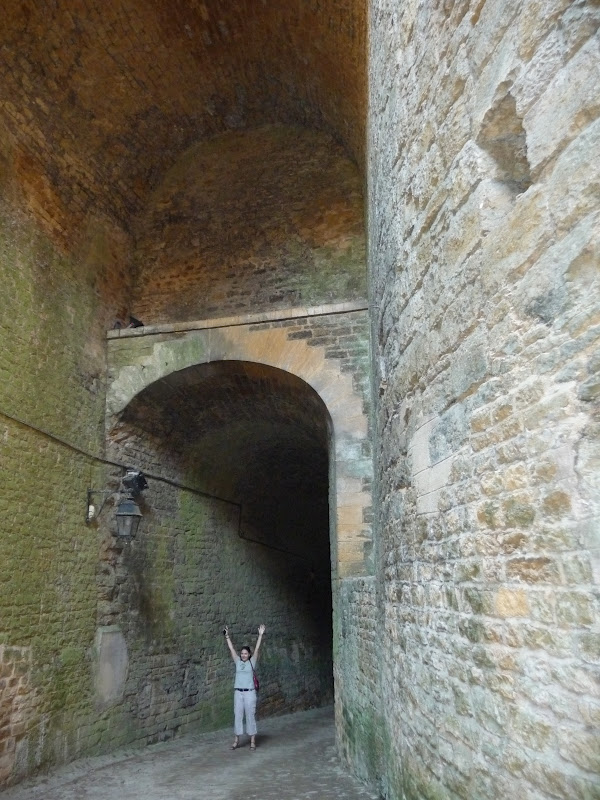
Below: an old passage (you don't need a map for the village - impossible to get lost!)
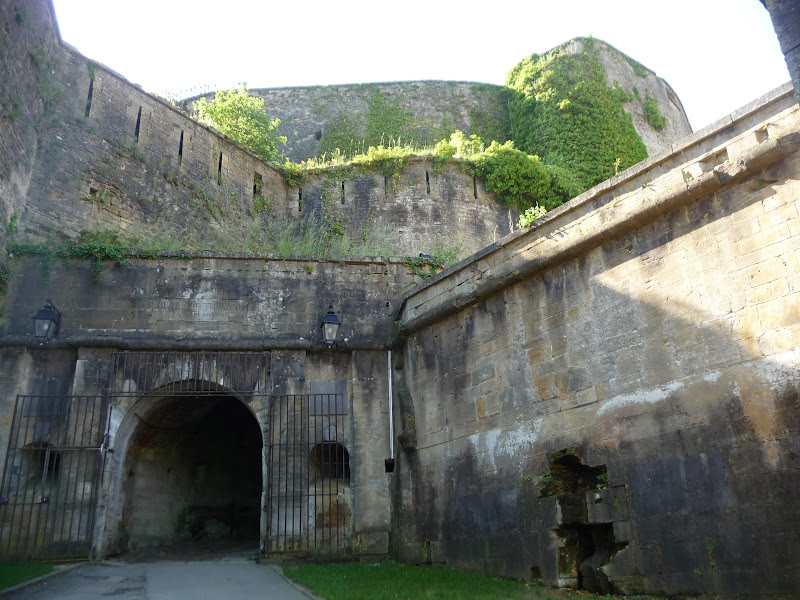
The fortification (it was after lunch, fortunately the weather improved by then)

At 2pm, like in the rest of France, places opened after the long lunch break, and we could fetch some brochures on the region as we have decided we would like to see other places in the vicinity, but were a bit unprepared, as we didn't expect to spend such a short time in Rocroy.  Escaping the cold by sitting in the car glancing through a handful of brochures and checking the distances on the GPS, we've settled for the Château de Montcornet.
Along the road (us still ooh-ing and aah-ing for the beautiful surroundings) we've passed people hiking, forests, more farms.  It is just one of those regions where, if you have beautiful weather (which we had by then), you can have an awesome time.
The château de Montcornet is one of the biggest medieval fortifications in the Ardenne.  At the end of the 10th-c the archbishops of Reims and the earls of Champagne wanted to secure this region against invasions from the Germanics.

The château changed hands over the centuries.  In 1303 the then owners built a chapel next to the château, the chapelle Sainte Marie Madeleine (recently restored). 
In 1446 the château was purchased by Antoine de Croy, a soldier and diplomat, who transformed the castle to suit artillery and iron balls.  Other owners to follow were Charles de Gonzague, a descendant of Richelieu and other marquis and dukes.  Today the castle hosts a museum, but unfortunately it was closed on the day that we have visited.
One can do an 1 hour walk around the castle - but considering the up and downhills it will comprise, we've used the excuse of not having enough time!


The village is beautiful, the wide clean tidy streets, neat stone houses, the gardeners were busy working the village gardens, you have a beautiful view from the castle.  Worth a visit!
Above: an arty creation of the castle in a garden
Below: a pretty guest house
Above: the beautiful view from the castle
Below: on the way back we first tried a small road but after a few nerve wrecking moments we've decided to join the bigger road asap. At one stage I had to stop for road works and I've managed to capture the beautiful surroundings from the car!


Sunday, July 8, 2012

Exploring the Ardenne region

Even though there are some French who are a bit snobbish towards the Ardenne, and even though it is not on the main tourist routes of France, it is really a beautiful region.  And except for numerous hikers you'll meet along the way, it is a pleasure to escape from the over 'touristy' areas.  Once you're in it and start exploring it, you realise there are far more to the Ardenne than just its natural beauty.  It is also steep in history.
We've done two trips to the Ardenne when having our visitors during May/June.  First via Sedan towards the Ardenne region of Belgium (Bouillon and Rochehaut which I have already covered in a post during last year) and then returning via Charleville-Mézières.
On the way to Sedan you pass the Woinic, the biggest wild pig in the world and an important symbol of the Ardenne where you will find saucisson made from wild pig on a regular basis (very good!).
The Woinic, along the highway and difficult to miss, is almost 10 m high, 14 m long and 5 m wide and weighs 50 t!  The sculptor Eric Sléziak designed and created the Woinic, starting on 1 January 1983 and 120 000 hours of work and 11 years later, completed his task on 11 December 1993.
The Woinic started its 55 km journey from the sculptor's workshop in Bogny-sur-Meuse on 4 August 2008 and reached its destination on 8 August 2008, written 08-08-08, the day of the century for the Ardenne people. I need to explain.  In France each department has a number. That number is used in numerous documentation, the postal code (the first 2 nrs in a postal code in France indicates which department the village is in), the car registration, etc.  And the number for the Ardenne is 08!

From there it wasn't far to Sedan with the largest fortified medieval castle in Europe, covering 35 000 m2 with its 7 storeys (and its walls thicker than 7 m!).  Sedan has observed much in history.  During the religious wars in France the Protestants were welcomed in Sedan where they contributed to its wealth.  Napolean III was captured in Sedan in 1870 in the Franco-Prussion war, the Germans occupied the castle for four years during WWI.  From Jan 1917 - Nov 1918 the castle was a place of extermination where thousands of civil French and Belgiums were condemned to hard labour, where they have met their death, for their acts of resistance.  180 000 people were send to camps in Germany and in the invaded Sedan 30 000 were killed as a result of 8 000 bombs.  And during WWII, the Germans first invaded Belgium from where they crossed the Meuse River and won the Second Battle of Sedan (12-15 May 1940).  By doing so they have not only bypassed the French fortification system, the Maginot Line, but it also enable them to entrap the Allied Forces that were advancing east into Belgium.

Each year during May Sedan hosts a medieval fête during which period (a weekend) the area around the château is fenced off and once inside, you can explore the numerous stands, shows, walk through people dressed in old fashioned clothes, visit little 'camps' where you can buy something to drink or eat.  For my mom, who had been there last year, it was quite a contrast to visit it this year again, but not during the fête.  From a complete buzz and squeezing your way through crowds, to silence, not much life around the castle.
Inside the courtyard of the castle where you'll find a hotel and a restaurant
From Sedan it was on towards Belgium to visit Bouillon's castle and have lunch at Rochehaut, where the weather started to change.
I'm not a beer drinker, but if there's one beer I do drink, it's the one of Rochehaut. So my friends had to taste it as well!
With the weather changing and having to be at the station in the evening to fetch JL, we've decided to return to France and visit Charleville-Mézières on the way back.  In 1966 the communities of Charleville and Mézières, with smaller communities in the vicinity, were all joined into one town.
The Romans built a road from Reims to Cologne, building a city in the bend of the Meuse river.  This city was destroyed by fire in the 10th-c, at which stage Mézières already existed not far from there.  In Mézières the church of the Notre-Dame was constructed from 1499-1601 and it was here that king Charles IX got married to Elisabeth of Austria in 1571.
In 1521 the cavalier Bayard defended Mézières against the imperial troops of Charles of Habsburg.  This battle had an important consequence for the development of the town, as its importance in the royal defence was acknowledged and it became a town enclosed by an important defense system.  Sadly Mézières was heavily bombarded during the last two days of WWI and 50% of the town was destroyed.

In 1606 Charles de Gonzague decided to construct Charleville.  (He was a French-Italien and duke of Rethel, also in the Ardenne, as well as Mantua in Italy, another place worth a visit.)  The site was chosen at a bend of the Meuse, on the site of the old Roman city.  One of the aims while constructing the new town was to rival Sedan, which became a Protestant stronghold.  Architect Clément II Métezeau, brother of the architect who designed Place des Vosges in Paris, was instructed to design Charleville's la Place Ducale, which reminds one of Place des Vosges.
Having coffee on the square
The ideal car to drive in France...
The statue of Charles de Gonzague
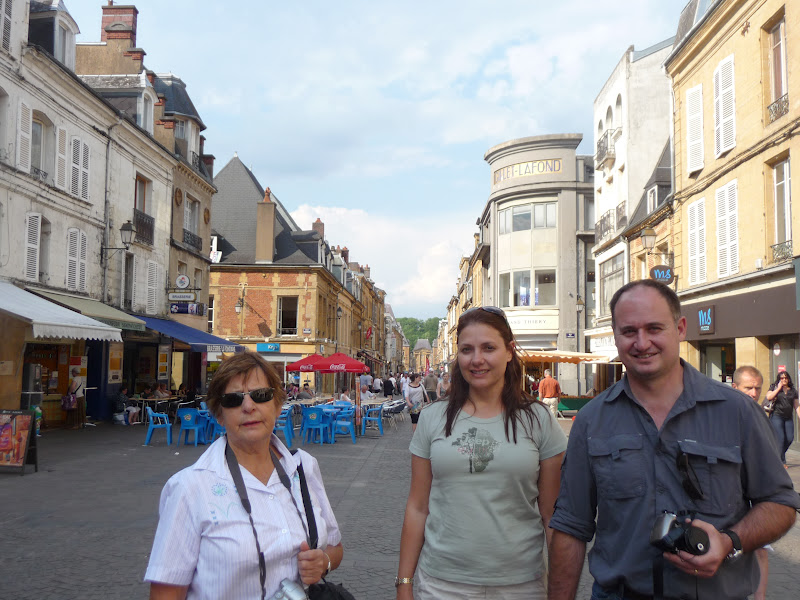
Wandering the pedestrian area of the town
Charleville-Mézières is also know for its international puppet show and Arthur Rimbaud, French poet who was born in Charleville in 1854.  The Rimbaud museum is hosted in an old mill.  To my surprise I got to know more about this child genius who wrote his first poems at the age of 15 and became a traveller and explorer (and suspicious dealer) in Africa in a book I am currently reading: Dark Star Safari by Paul Theroux (good book to read).  The book covers his travel from Cairo to Cape Town and in the walled city of Harar he writes about Rimbaud who lived there, not wanting people to know who he was or where he comes from.  Until a French explorer saw his name and told his boss who Arthur Rimbaud is. Now I'll have to go back to visit the museum!
Above & below: the museum in the old mill
Above: houseboats along the Meuse
Below: a park bordering the river and the museum


Sunday, July 1, 2012

Nina's blanquette de veau

With all our visitors that we have had the French traditional dishes didn't stay behind, as we love introducing our visitors to the French culture.
Shortly after my mom arrived Nina came to visit us for the weekend and offered to make a blanquette de veau (veal stew) for the Sunday.  We were happy to hand to kitchen over to her and have some time off.  Blanquette de veau is one of the most popular traditional dishes in France.  I first had it in Fouras when JL's sister cooked it for us.
It is a dish that takes long to cook (and long to prepare as you need to remove the fat from the meat), but is absolute worth it.  We had an excellent meal and I'll hand the kitchen over to Nina in the future at any occasion!  She took a recipe of the internet, but changed it based on her past experience, so I am happy to share her recipe with you!  It is an ideal dish to have in the winter!!

For 6 people:
Ingredients:
1.5 kg of veal (if you have the benefit of a butcher close to you, ask him to cut the veal pieces that are not too fatty)
1 marrow bone
1 bouquet garni (thyme, rosemary, parsley, laurier, pepper - we buy bouquet garni in a spice bottle instead of making a fresh one and she used almost a full bottle!)
2 carrots
300 g white mushrooms
1 leek (that is one good thing of buying vegetables in France - you can buy 1 leek and even if you buy celery, you don't have to buy the bush, but can ask for only one stem!)
young onions (the ones with the long green stem and a small white bulb)
juice of 1/2 a lemon
2 soup spoons of flour
2 soup spoons of butter
250 ml of cream
1 egg yolk
salt
cloves

Put the meat, salt, bone, bouquet garni, carrots (cut in round slices) and the onions (put 3 cloves in the onions) in a casserole.  Cover with cold water and boil that it is foaming.
Simmer for 2 hours, add the mushrooms and simmer for another 30 min.
On a low heat, whisk the butter and flouer for 5 min in a casserole and remove from the heat.
Once the meat is cooked, pour it through a sieve and throw away the onion and the bouquet garni.  Put the meat, carrots and mushrooms in a dish.
Incorporate the veal stock with the butter and flour and whisk to acquire a smooth sauce.  Put back on stove and cook for 5 min while continuing to whisk (it won't be thick, but cover a sppon). Add the lemon juice and cook another 2 min.
At the same time beat the cream and egg yolk together, add salt and pepper if required. Then mix with the sauce.
Add the meat, carrots and mushrooms to the sauce that it is cover, for about 2 min.
Enjoy!

Tuesday, June 19, 2012

Mailly's gastronomy fête

I was a bit too optimistic to think I'll be able to blog while having visitors...
Nerina and Hennie arrived during the weekend of the gastronomy fête of our neighbouring village, Mailly.  It was a long weekend, as the Monday was a public holiday (although a special one in France, as some companies may choose to work on this one with the salaries of that day being donated to charity organisations - don't ask me the detail of how it works. Some things in France you just aceept, you don't try to figure it out...).  The Sunday afternoon on our way back home from Hautvillers, a champagne village on the other side of the Montagne de Reims, we had to pass through Mailly's main road and they could see the streets, all being pedestrianised during the festival, packed with people.  We had plan to walk the Monday, as it is only about 2.5 km, but after dropping JL at the station, I told them it will get very hot, it will be better to drive.  Being the driver I'll just take care on the wine tasting.  So off we went, making sure we'll arrive after 10 am, as I have been lecturing them quite a bit that nothing happens before 10 in France...
Fortunately we have arrived before the crowds and parking was easy to find...

One pays an entry fee of 5€ but for that you get a tasting glass and you can taste as much food and wine as you wish.  Since JL and I have been there last year as well, I glanced at my list of good wine places to be revisited, to save my mom and friends the difficulty of tasting too many wines before finding the best. (For somebody not fond of admin - my brochures and notes of last year were actually filed under Mailly Foire Gastronomique...)
However, just after the entrance we temporarily ignored my list and tasted some champagne from Mailly, as Nerina & Hennie only arrived the day before and still had to explore champagne.  The house had a very good rosé champagne and we've decided we'll buy one on the way back to drink with the salmon that evening.
In the champagne house
Then their tour of good Burgundy wines started.  The best two stands of last year were just around the corner...


We have tasted Auxey-Duresses of different years to compare, Monthélie, Pommard, Santenay, Chassagne-Montrachet....Or should I say, I have submerged/drowned my visitors in Bourgogne wines?  By lunch time we had tasted 10 wines, including the champagne.  My mother gave up before the end.  After the Montrachet (one of the best and most expensive Bourgogne wines) she didn't want to taste any other wine, convinced nothing can compare to that, even though she normally doesn't like white wine.  When the winery heard that, they offered my mom another glass of Montrachet and we had a good laugh at her jumping at that opportunity.  I don't think the family back home would have recognised her!  For the sake of the uninformed - these Bourgogne wines are all either Pinot Noir or Chardonnay, but as France do not use the grape variety in the name, but that of the region, these are all different regions you'll find in Bourgogne.  And you'll appreciate that a Pinot Noir from Pommard does not taste like a Pinot Noir from Auxey-Duresse.
After all these wines, and buying some paté (which I afterwards agreed with JL is not the best, but after so many tastings it was super) we had to eat lunch.  Still lecturing my visitors about French gastronomy, we had a croque monsieur with a twist for lunch, with the strong smelly tasty cheese from the North - Maroille.  By then the driver decided to be more prudent and the white Meursault of Bourgogne N&H had to taste alone, 5 different types from the same wine grower. 
getting a lecture on Meursault wines
Then it was St Emilion, Chablis, Pineau, Montbazillac, oysters from the west coast (and Nerina decided she'll have to buy some for dinner), jambon (ham) and cheese from Bayonne, saucisson and cheese from the Savoy...
Mmm, delicious!!!!!!!
Below: these two guys must have thought we had far too much to drink. We were laughing so much.  After tasting the first piece of jambon we got a second, cut a bit thicker. I've said after tasting that I prefer the first and Nerina & my mom agreed, to which Hennie was saying but both were the same. We were mocking him, saying he had too much to drink. Just to be told by the guy after enquiring more that both were the same! Then we were laughing at ourselves!

We even had some street entertainment. Spot the lady in the blue dress in the back pushing the amp!

We left with arms full of wine and food, thankful that the car was not far. 

At the gate we were handed a gadget that measure your alcohol levels.  As Nerina was forced to taste the most (even Hennie gave up towards the end), she had to test it.  Thanks to the long time that we have spent at the fête she was fine (although it took us some time to figure out the gadget...).
The evening we continued at home with our own fête...